
What Does Your Archetype Have to Tell You?
The Major Arcana can be understood as a journey through some of the great archetypal experiences of being human. Beginnings and endings, love and loss, innocence and wisdom, courage and uncertainty, power and surrender, transformation and renewal all appear within these 22 cards.
Find the description of your chosen card below. Rather than thinking of it as a prediction, allow its imagery and archetype to become a starting point for reflection.
Why might this particular archetype have found you now?
-
0 · THE FOOL
The Fool stands at the beginning of the journey, carrying very little with him. He doesn't know exactly where the road will lead, and that is part of his power. He represents the part of us willing to step into unfamiliar territory before we have all the answers.
Every new beginning asks us to surrender something of the certainty we already know. The Fool can appear when we are contemplating change, feeling the pull towards something new, or beginning to realise that the life we have become accustomed to may no longer be quite big enough for us.
Perhaps there is an area of your life where you are standing at the edge of something new. You may already know what it is, a relationship, a change of direction, a creative idea, a journey or a decision you have been circling for some time. Or perhaps nothing obvious is changing externally, but somewhere inside you there is a growing desire for greater freedom.
The Fool doesn't necessarily tell you to leap without looking. Instead, he asks you to notice where fear of the unknown may be competing with curiosity.
Where would you go if you didn't need to know exactly how everything would turn out?
The astrological connection
The Fool is traditionally associated with Air, the element of thought, movement, curiosity and possibility. In modern astrological Tarot, he is also frequently associated with Uranus, the planet of freedom, awakening, individuality and unexpected change.
Air wants room to move. It asks questions, explores possibilities and resists becoming trapped in a single way of seeing things. The Uranian dimension adds independence and the courage to depart from convention when the old route no longer feels authentic.
If you have drawn The Fool, it might be interesting to consider your relationship with Air. Do you welcome new ideas and possibilities, or does uncertainty make you uncomfortable? Is Air strongly represented in your chart, or might The Fool be inviting you into a quality that feels less familiar?
Your natal Uranus adds another layer. Its sign, house and aspects can show where you need freedom, where you may resist convention and where life periodically asks you to reinvent yourself.
And what is Uranus doing in your chart now? Sometimes the desire for change becomes particularly strong because an important part of the birth chart is being activated.
Tarot can take the story further. What are you leaving behind? What is calling you forward? What might help you make the leap wisely?
-
I · THE MAGICIAN
The Magician stands before his tools with everything he needs at his disposal. He represents the moment when an idea can become something more, when thought, intention and possibility begin to take form.
This is a card of resourcefulness. You may already possess more of what you need than you realise, knowledge, experience, contacts, skills or simply an idea that has been waiting for you to do something with it.
The Magician can also draw attention to the way you use your mind and your words. What are you telling yourself is possible? What are you communicating to others? Where is your attention going? His gift is the ability to connect apparently separate things and create something from them, although his shadow can appear when cleverness becomes manipulation, when attention becomes scattered or when we remain in the world of ideas without bringing anything into reality.
If you have drawn The Magician, perhaps there is something in your life that is ready to move from thinking into doing.
What could you create if you fully recognised the resources you already have?
The astrological connection
The Magician is associated with Mercury, the planet of thought, communication, language, learning, curiosity and connection.
Mercury rules Gemini, an Air sign, and this gives us a particularly useful way of understanding The Magician. Air is the element of ideas, communication, movement and perspective. It makes connections. One thought leads to another, one conversation opens a door, one piece of information changes how we understand everything else.
If you have drawn The Magician, consider your relationship with Air. Is your mind constantly making connections? Do ideas come quickly? Are words and communication natural strengths? Or is Air less strongly represented in your chart, making The Magician's invitation to communicate, experiment and engage with new ideas particularly interesting?
Your natal Mercury takes this further. Its sign, house and aspects can tell us how your mind works, how you communicate and where your particular intellectual or communicative gifts lie.
And what is Mercury doing in your chart now? Is something asking to be spoken, written, learned, negotiated or created?
Tarot can reveal which of your tools are ready to be used, what may be scattering your energy and what could happen when intention becomes action.
-
II · THE HIGH PRIESTESS
The High Priestess inhabits the space between what we consciously know and what we somehow sense. She represents intuition, mystery, dreams and the quieter forms of knowledge that cannot always be explained rationally.
She can appear when there is more happening beneath the surface than is immediately visible. Perhaps you already know something but have been overriding that knowing with logic, other people's opinions or the desire for certainty.
The High Priestess doesn't necessarily ask you to act. Sometimes her invitation is simply to listen. She reminds us that not every answer arrives through effort and that periods of waiting, observing and allowing can have their own intelligence.
If you have drawn her, notice what you have been sensing lately. Pay attention to dreams, recurring feelings, synchronicities and those moments when you seem to know something before you know why.
What might you hear if you trusted the quieter voice within you?
The astrological connection
The High Priestess is associated with the Moon, our emotional and instinctive world, memory, receptivity and the rhythms beneath conscious awareness.
The Moon belongs naturally to the realm of Water, the element of feeling, intuition, sensitivity, emotional connection and flow. Water doesn't need to understand something intellectually before responding to it. It feels its way.
If you have drawn The High Priestess, consider your relationship with Water. Do you trust your feelings and intuition, or do you tend to question them? Do you absorb the atmosphere and emotions around you? Or is Water less strongly represented in your chart, making this quieter, more receptive way of knowing something you are being invited to explore?
Your natal Moon adds another layer. Its sign, house and aspects can tell us about your emotional nature, what makes you feel safe and how you instinctively respond to life.
We can also look at what is happening to your Moon now, and whether current planetary cycles might help explain why this particular archetype feels significant at this point in your life.
Tarot can take us deeper, exploring what may be moving beneath the surface and what your intuition has perhaps already been trying to tell you.
-
III · THE EMPRESS
The Empress is abundant, sensual and fertile. She represents our capacity to nurture something until it becomes fully alive.
That something might be a child, but it could equally be a relationship, a garden, a business, a home, an artistic practice, an idea, or a part of yourself that has been waiting for attention.
She asks a deceptively simple question: what are you feeding?
Look at where your time, love and energy actually go. What flourishes because you tend it? What have you patiently brought into being? And perhaps more interestingly, is the life you are nourishing also nourishing you?
For people who instinctively care for others, The Empress can raise questions about receiving. Giving may feel entirely natural, while accepting attention, support, pleasure or even praise can feel strangely unfamiliar.
At other times she appears because something has been neglected. Creativity has been postponed, the body ignored, pleasure treated as unnecessary, or an idea repeatedly pushed aside because apparently more important things came first.
The Empress reminds us that pleasure, beauty, touch, food, nature, creativity and rest are not frivolous additions to life. They are part of being alive.
Her shadow can be overgiving or over-nurturing. Care can become smothering, or we can become so accustomed to being needed that we lose sight of our own needs. We can also pour enormous amounts of energy into something that simply isn't fertile ground.
What are you helping to grow, and what might begin to flourish if some of that care were directed towards you?
The astrological connection
The Empress is traditionally associated with Venus, the planet of love, attraction, pleasure, beauty, creativity and value.
Astrologically, Venus rules two signs, Taurus and Libra, and each reveals a different dimension of this archetype.
Through Taurus we meet Venus in Earth: the body, sensuality, nature, fertility, resources and the patient cultivation of something until it takes tangible form. Through Libra we encounter Venus through relationship: attraction, harmony, reciprocity and the balance between giving and receiving.
The Empress herself feels profoundly earthy. She doesn't simply imagine or desire creation, she gestates it. Something is given time, attention and nourishment until it acquires substance and life of its own.
Your natal Venus makes this much more personal. Its sign, house and aspects can tell us about what you value, what attracts you, how you experience pleasure and affection, and something about the particular way you give and receive love.
Taurus and Libra add another layer. Where Taurus falls in your chart can show where stability, embodiment and lasting value matter, while Libra can reveal where relationship, exchange and reciprocity become especially important.
And what is happening to Venus in your chart now?
Current transits may be bringing relationships, creativity, money, pleasure or questions of value into greater focus. Sometimes The Empress appears when what is changing is not simply what we love, but what we are prepared to give our life energy to.
Tarot can take that question further. What are you nurturing? Is it fertile? What is receiving too much of you? And what in your own life might now be asking to be tended?
-
IV · THE EMPEROR
The Emperor sits firmly on his throne. He knows where his territory begins and ends.
At his best, he represents healthy authority, boundaries, protection and the ability to create enough structure for something to survive. He is the part of us that can make a decision, establish a position and take responsibility for what happens next.
Perhaps you have drawn him because something in your life needs firmer edges.
You may have been negotiating something that actually requires a decision. Perhaps somebody repeatedly crosses a boundary you haven't quite enforced. Or you may be waiting for another person to give you permission to do something that is fundamentally yours to decide.
The Emperor therefore asks an interesting question: how comfortable are you with your own authority?
For some people this archetype feels natural. For others, authority has been experienced as controlling, punitive or inflexible, making the idea of claiming authority for themselves more complicated. Yet there is an important difference between power over somebody else and authority within your own life.
The Emperor doesn't have to dominate in order to be powerful. At his best, he creates clarity. This is where I stand. This is what I will accept. This is what I am responsible for, and this is what belongs to somebody else.
His shadow appears when structure becomes rigidity, protection becomes control, or certainty becomes an inability to listen. Equally, we can reject the Emperor altogether and discover that without boundaries or structure, other people begin making decisions for us.
Where in your life might greater clarity, structure or self-authority change the situation?
The astrological connection
The Emperor corresponds with Aries, the first sign of the zodiac. Aries is ruled by Mars and belongs to the element of Fire.
This matters because Aries does not wait for consensus before existing. Its fundamental impulse is towards action, autonomy and self-definition. Before there is we, Aries establishes I.
The Fire of The Emperor is therefore not simply enthusiasm or passion. It is directed will. Fire initiates. It separates one thing from another, gives us the courage to act and allows desire to become movement.
But Fire also needs direction. Without it, assertion can become aggression, confidence can harden into dominance, and the desire to lead can become an inability to compromise. Too little Fire creates a different difficulty: knowing what you want but repeatedly hesitating to act upon it.
Your natal Mars makes this archetype much more personal. Its sign, house and aspects can describe how you pursue what you want, assert yourself, respond to challenge and express anger or desire. Mars can also show something about how comfortable you are with taking decisive action.
Then there is Aries in your own chart. The house containing Aries identifies an area of life where independence, initiative and the right to act on your own behalf may be especially significant.
And what are Mars and Aries doing in your chart now?
Current transits can bring questions of autonomy, leadership, conflict, boundaries or decisive action sharply into focus. Sometimes The Emperor arrives not because you need to become more forceful, but because something requires you to become clearer about where you stand.
Tarot can take that further. Where is your authority genuinely needed? Where might you be giving it away? Where has healthy structure become control? And what would change if you stopped waiting for somebody else to establish the terms?
-
V · THE HIEROPHANT
Before you ever consciously decided what you believed, you inherited an enormous amount.
Ideas about love, success, family, money, morality, gender, spirituality, work and what a respectable life should look like were already circulating around you. Some came from family, some from education, religion or culture, and some were absorbed so quietly that they may never have felt like beliefs at all.
The Hierophant represents this world of teaching, tradition and inherited wisdom.
Sometimes he appears because we need guidance. There is value in learning from somebody who has travelled a road before us, and not everything inherited needs to be dismantled simply because it is old. Tradition can connect us to knowledge accumulated across generations. A teacher, mentor, philosophy or spiritual practice can give shape to something we have sensed but not yet known how to articulate.
But The Hierophant becomes particularly interesting when received wisdom and lived experience begin to disagree.
Perhaps you are following a rule whose origin you have never questioned. Something may have been presented as simply “the way things are”, when in fact it belongs to a particular family, culture, institution or generation.
At that point The Hierophant asks us to distinguish between tradition and truth.
What have you learned because experience has shown you its value, and what do you believe because somebody once told you that you should?
His shadow appears when teaching becomes dogma, when belonging requires conformity, or when an authority is given greater weight than our own experience. But there is a shadow on the other side too. Rejecting every tradition or authority simply because it represents convention can leave us continually reinventing wisdom that already exists.
The mature Hierophant can listen to the teacher without surrendering his own discernment.
Which of your beliefs have earned their place in your life, and which might be ready to be questioned?
The astrological connection
The Hierophant corresponds with Taurus, an Earth sign ruled by Venus.
This gives us a very different expression of Venus from The Empress. With The Empress, Venus was fertile, sensual and creative. Here, Venus asks a more fundamental question: what do you value enough to preserve?
Taurus is concerned with stability, continuity and what can be relied upon. Earth learns through experience. It wants to know whether an idea actually works when brought into contact with real life.
This is why tradition belongs so naturally to The Hierophant. Customs, rituals and systems of knowledge endure because somebody considers them worth carrying forward. At their best they give us roots, language and a sense of belonging.
But Earth can also become fixed.
Something can feel true simply because it is familiar. A belief repeated for thirty years acquires weight, even when nobody remembers why it was adopted in the first place. The Hierophant therefore asks us not simply whether a tradition is old, but whether it is still alive.
In your birth chart, Taurus can show an area of life where stability, continuity and deeply held values become particularly important. Your natal Venus, its sign, house and aspects, tells us much more about what you genuinely value, rather than what you have been taught to value.
And what is happening to Taurus and Venus in your chart now?
Current transits can coincide with periods when an established value, belief, institution or way of living is being strengthened, questioned or reconsidered. Sometimes the challenge is to leave an old system. At other times, surprisingly, it is to recognise the value of structure, commitment or guidance after a period of resisting it.
Tarot can take the enquiry further. Who taught you what you believe? Which teachings still contain wisdom? Which have become rules without meaning? And what might you choose to carry forward once you realise that inheritance does not have to mean obedience?
-
VI · THE LOVERS
The Lovers is often reduced to romance, but love is only part of its story.
At its heart, this card concerns choice.
Every meaningful choice contains a separation. To choose one person, path or version of your life means acknowledging what you are not choosing. This is partly why important decisions can feel so difficult, even when we know what we want.
Perhaps there is a relationship at the centre of your thoughts. If so, The Lovers may ask what that person awakens in you.
Relationships can become extraordinary mirrors. We encounter qualities in another person that attract, fascinate, irritate or unsettle us, sometimes because they reveal something about ourselves. We may be drawn towards somebody who embodies a freedom we haven't allowed ourselves, or find ourselves repeatedly encountering the same dynamic in different relationships.
But The Lovers may have nothing to do with romance.
You might be choosing between security and freedom, responsibility and desire, what is expected and what feels authentic. Sometimes the real choice is between two different versions of yourself.
This is why The Lovers is also a card of alignment. A choice can look perfectly sensible from the outside and still feel wrong internally. Another may be difficult to explain yet feel much closer to who you are becoming.
The shadow of The Lovers is endless indecision, keeping every possibility alive so that nothing has to be relinquished. It can also be losing ourselves in another person, mistaking attraction for compatibility, or allowing somebody else's desires to make the choice for us.
What are you choosing, and does that choice reflect what you genuinely value?
The astrological connection
The Lovers corresponds with Gemini, an Air sign ruled by Mercury.
This is an intriguing correspondence because Gemini is symbolised by the Twins. Immediately we encounter two: self and other, one path and another, one point of view alongside its alternative.
Air gives us the ability to stand back, compare, question and imagine possibilities. Mercury adds language and exchange. Through conversation we discover not only another person's mind, but often our own. Sometimes we don't know what we think until we hear ourselves say it.
But the great gift of Air can also become its difficulty.
The mind can produce another argument, another possibility and another interpretation indefinitely. Gemini can see both sides, and The Lovers reminds us that eventually a life cannot be lived entirely in possibility. Something has to be chosen.
Your natal Mercury, its sign, house and aspects, can tell us much more about how you communicate, process information and make sense of competing possibilities. Gemini's house in your chart shows an area of life where curiosity, exchange, movement and multiplicity may be especially important.
And if another person is central to your Lovers story, astrology gives us another fascinating layer through synastry.
Comparing two birth charts can show where two people naturally understand one another, where attraction or tension arises, what one person awakens in the other, and why certain relationships can feel unusually significant. It doesn't tell us whether two people “should” be together, but it can illuminate the particular conversation taking place between them.
And what is happening to Mercury, Gemini, or your relationship planets now?
Current transits can coincide with important conversations, decisions, encounters or periods when an existing relationship is asking to be understood differently.
Tarot can then take us beneath the obvious question. What are you really choosing? What is this person or possibility awakening in you? What would each path require you to leave behind? And which choice brings you into greater alignment with the person you are becoming?
-
VII · THE CHARIOT
The Chariot is moving, but look closely and you discover that movement is not as straightforward as it first appears.
Two creatures pull in different directions.
That is often exactly how change feels.
One part of you may desperately want to move forward while another wants to remain where it feels safe. You may want independence while fearing what it could cost. You may know where you want to go, yet find yourself repeatedly pulled back towards something familiar.
The Chariot doesn't require those contradictions to disappear before you can move. Instead, it asks whether you can recognise the different forces within you and still take the reins.
Sometimes this card appears around literal travel, relocation, career ambition or a determined push towards a goal. At other times the journey is internal. Something in your life may be asking you to separate from an old identity, expectation or emotional attachment without denying that it once mattered.
There is a subtle difference between moving forward and running away.
The Chariot's strength comes from direction. It knows what it is moving towards. Its shadow appears when movement becomes an end in itself, when determination prevents us from noticing exhaustion, or when success becomes more important than asking whether the destination still belongs to us.
Equally, conflicting feelings don't necessarily mean that you are on the wrong path. Sometimes we can want something deeply and still grieve what must be left behind in order to reach it.
Where are you ready to move forward, even though part of you is still looking back?
The astrological connection
The Chariot corresponds with Cancer, a cardinal Water sign ruled by the Moon.
At first this can seem like a curious correspondence. The Chariot looks determined, active and outwardly directed, while Cancer is associated with home, belonging, memory and emotional security.
But Cancer is cardinal, and cardinal signs initiate. Cancer may be deeply connected to home and emotional security, but it is not passive. Its instinct is to act in order to protect, establish and create what it needs. This gives us an important key to The Chariot: movement can arise not in spite of our emotional needs, but because of them.
Put Cancer's cardinal drive together with the Moon's instinctive responses and the symbolism of The Chariot becomes much more interesting.
How do we move forward while carrying where we came from?
Cancer's Water remembers. It carries emotional history, attachments and the instinctive knowledge of what has made us feel safe. The Moon describes our emotional responses, habits and needs, many of which operate before conscious thought has had time to intervene.
So the Water of The Chariot isn't passive. It is the emotional current underneath the movement.
Sometimes that current supports us. A strong sense of belonging can give us the confidence to venture far beyond what is familiar. At other times attachment becomes the force pulling in the opposite direction. We may consciously want change while another part of us associates change with losing safety, connection or home.
Your natal Moon, its sign, house and aspects, can tell us much more about what you need in order to feel emotionally secure, how you instinctively protect yourself and what you return to when life feels uncertain.
Then there is Cancer in your chart. Its house can show an area of life where questions of belonging, protection, family, memory or emotional attachment have particular significance.
And what is happening to your Moon and Cancer now?
Current transits can coincide with changes involving home, family, belonging or emotional security, but they can also describe periods when an old emotional response is being stirred because life is asking you to move somewhere new.
Tarot can help identify the two forces pulling your Chariot. What is calling you forward? What is pulling you back? Is the hesitation warning you about something important, or simply asking for reassurance before you move? And what would it mean to take the reins without abandoning the part of you that still needs to feel safe?
-
VIII · STRENGTH
Strength presents us with an unusual image of power.
There is no battle. The lion has not been defeated, imprisoned or driven away. Instead, the woman approaches it calmly, placing her hands around its jaws.
The animal remains powerful, but a relationship has been established between instinct and consciousness.
The lion can represent many things: desire, anger, sexuality, ambition, fear, creativity, pride, vitality, even the sheer force of wanting something. These energies are not inherently dangerous. They are part of what makes us alive.
Strength asks what happens when we stop treating those powerful instincts as something that must either control us or be controlled.
Perhaps there is something you feel strongly about. The temptation may be to suppress it, particularly if the feeling seems inconvenient, excessive or difficult to express. Or the opposite may happen and the feeling takes over, leaving little room for reflection.
Strength offers another possibility: to remain in relationship with what you feel without immediately acting upon it or pushing it away.
That requires a quieter kind of courage.
The card can also appear when something requires stamina rather than force. There are situations we cannot conquer in a single decisive moment. We simply have to keep showing up, maintaining our position and trusting that consistency can sometimes accomplish what force cannot.
Its shadow can appear as domination, pride or the need to prove our strength. But it can also appear when we mistrust our own intensity and make ourselves smaller because we are afraid of what might happen if we fully inhabit it.
What might change if you stopped fighting your own power and learned how to work with it instead?
The astrological connection
Strength corresponds with Leo, a fixed Fire sign ruled by the Sun.
Fire represents vitality, creativity, desire, courage and the impulse towards self-expression. But Leo's Fire is fixed, and that distinction is important.
This isn't simply the spark that starts something. Fixed Fire sustains the flame.
Leo has staying power. It can remain committed to what matters, continue creating when the first rush of inspiration has passed, and hold its position when circumstances become difficult. This gives us another way of understanding Strength. Courage is not always dramatic. Sometimes courage is the capacity to stay present.
The lion itself makes the Leo symbolism beautifully explicit. It represents vitality, instinct and sovereign power, while the woman does not destroy or diminish that power. She meets it.
This is also where the Sun, Leo's ruler, becomes important. Astrologically, the Sun represents the central organising principle of the self, our vitality, creative identity and the developing sense of who we are. Strength asks how comfortably we inhabit that life force.
Fixed Fire has a shadow too. Steadfastness can become stubbornness. Confidence can become pride. Loyalty can keep us attached to something long after circumstances have changed. The same fire that sustains us can become exhausting if we believe we must remain strong indefinitely.
Your natal Sun, its sign, house and aspects, can tell us much more about where and how you seek to express your individuality and vitality. Leo's house in your chart can show an area of life where creativity, visibility, courage and authentic self-expression may be especially important.
And what is happening to your Sun and Leo now?
Current transits can coincide with periods when confidence, identity, creativity or the courage to occupy more space in your own life becomes significant. Sometimes the challenge is to find your strength. At other times it is to discover that strength does not require constant force.
Tarot can take that further. What is the lion for you? Are you suppressing it, being ruled by it, or learning to work with it? Where is endurance more useful than force? And what part of your own vitality might be asking not to be tamed, but consciously embraced?
-
IX · THE HERMIT
The Hermit steps away from the noise of the world in order to hear something quieter.
He carries a lantern, but it illuminates only a small part of the path ahead. There is something important in that image. We don't always need to know where an entire journey is leading. Sometimes we need enough light to see the next step clearly.
The Hermit can appear when solitude, reflection or a temporary withdrawal from other people's opinions would be useful. Not necessarily because anything is wrong, but because there are moments when the answer we are looking for becomes harder to hear amid advice, expectation and distraction.
There is a difference between being alone and being lonely.
Chosen solitude can create the space in which thoughts settle and something more considered emerges. The Hermit may therefore represent a period of study, contemplation or simply slowing down enough to notice what you actually think.
He can also represent the wise person or guide, somebody whose understanding has developed through experience rather than theory alone. And sometimes we discover that the guide we have been searching for externally has gradually become part of ourselves.
But The Hermit has a shadow. Reflection can become isolation. We can remain on the mountain for so long that contemplation becomes avoidance, or become so self-reliant that we stop allowing other people to contribute anything to our lives.
The question is not simply whether you need solitude, but what you are doing with it.
What becomes easier to hear when the voices around you become quieter?
The astrological connection
The Hermit corresponds with Virgo, a mutable Earth sign ruled by Mercury.
This is another fascinating expression of Mercury. In The Magician, Mercury was active, dexterous and outwardly engaged. Here Mercury turns its attention inward, observing, analysing and discriminating between what is useful and what is merely noise.
Virgo's Earth quality matters. The Hermit's wisdom isn't abstract philosophy for its own sake. He is looking for understanding that can actually be applied. Earth asks: what is useful, what works, and what can I do with what I have learned?
And Virgo is mutable Earth.
Mutable signs adapt, refine and prepare for transition. Virgo examines what has accumulated and decides what is still useful, what needs adjusting and what can be left behind. This gives The Hermit's withdrawal a purpose. He isn't retreating permanently from life. He is creating enough distance to see more clearly before returning to it.
Virgo's gift for discernment can, of course, become excessive. Careful observation can turn into over-analysis, discernment into criticism, and the search for the right answer into a reluctance to act until everything has been examined.
Your natal Mercury, its sign, house and aspects, can tell us much more about how you think, process information and make sense of experience. Virgo's house in your chart can show an area of life where discernment, improvement, skill and attention to detail have particular significance.
And what is happening to Mercury and Virgo now?
Current transits can describe periods of reassessment, study or mental reorganisation, times when you are being asked to reconsider how something works rather than simply continuing because it has always been done that way.
Tarot can take the enquiry further. What are you trying to understand? Which voices are helping you and which are obscuring your own judgement? Do you need more information, or simply more quiet? And if you held the lantern yourself, what would you already be able to see?
-
X · WHEEL OF FORTUNE
The Wheel of Fortune reminds us that life does not stand still.
Circumstances change, opportunities appear, plans are interrupted and sometimes events take us somewhere we could never have anticipated. We may experience these turning points as fortunate or difficult, but often we only understand their significance much later.
The Wheel can appear when something is already beginning to shift.
Perhaps a situation that has felt static is moving again. An unexpected opportunity may have appeared, or circumstances beyond your control are changing the direction of travel. Sometimes the card arrives at one of those strange moments when several seemingly unrelated things begin moving at once.
There is an element of chance here, but The Wheel isn't simply a card of good luck.
It asks us to consider our relationship with change itself.
When life turns in our favour, can we recognise the opportunity and participate in it? When circumstances move in a direction we didn't choose, can we adapt without assuming that the entire story has already been decided?
The wheel also introduces the idea of cycles. Experiences repeat, although rarely in exactly the same form. We can find ourselves returning to familiar themes, relationships or questions, but each revolution offers the possibility of meeting them from a different position.
Its shadow can be passivity, waiting for fate to intervene rather than recognising where we still have agency. The opposite is believing we should be able to control everything, and experiencing every unexpected change as a failure of planning.
The Wheel sits somewhere between the two.
What is changing around you, and where do you still have a choice about how you meet that change?
The astrological connection
The Wheel of Fortune corresponds with Jupiter, the planet traditionally associated with expansion, opportunity, growth, meaning and the widening of horizons.
Unlike the cards we've just explored, The Wheel is assigned directly to a planet rather than a zodiac sign. That distinction is worth making because it means there isn't one formal zodiacal modality attached to this card in the same way that The Chariot is cardinal Cancer, Strength fixed Leo or The Hermit mutable Virgo.
Jupiter traditionally rules Sagittarius and Pisces. Through Sagittarius we encounter the search for meaning, exploration, knowledge and the desire to see what lies beyond familiar boundaries. Through Pisces, Jupiter's traditional rulership speaks more to faith, imagination and the sense that life may contain connections or possibilities we cannot entirely explain.
Jupiter's elemental expression therefore isn't confined to one element. Sagittarius brings Fire, with its appetite for experience, movement and possibility, while Pisces brings Water, with its receptivity, faith and willingness to move with something larger than conscious intention.
This suits The Wheel remarkably well.
Jupiter tends to enlarge whatever it touches. Sometimes that feels like opportunity, confidence or liberation. At other times expansion can become excess, overconfidence or taking on more than we can realistically contain. Not every open door needs to be walked through.
Your natal Jupiter, its sign, house and aspects, can tell us where growth, meaning, opportunity and the desire for greater experience become particularly important in your life. It can also show where you may naturally expect things to work out, sometimes with good reason and sometimes because Jupiter's optimism has outrun the evidence.
And what is happening to Jupiter in your chart now?
Jupiter transits can coincide with periods of expansion, new possibilities and changing perspectives. They may bring opportunities, but astrology becomes much more interesting when we ask what kind of opportunity, in which area of life, and what it asks of you in return.
The Wheel reminds us that timing matters. We cannot control when every door opens or closes, but we can become more conscious of what we do when circumstances begin to turn.
Tarot can take that further. What cycle are you in now? Have you been here before in another form? What is genuinely outside your control, and where do you still have agency? Most importantly, if the wheel is already turning, how might you move with it rather than trying to hold it still?
-
XI · JUSTICE
Justice holds the scales in one hand and the sword in the other.
The scales weigh and compare. The sword cuts through confusion. Together they suggest that clarity sometimes requires us to look at a situation as it actually is, rather than as we hoped it would be.
Justice often appears when something needs to be weighed carefully.
There may be a decision to make, a situation requiring greater objectivity, or a question about fairness, responsibility or consequence. Sometimes the card appears quite literally around agreements, contracts or legal matters, but its meaning extends much further than this.
It asks us to consider the relationship between choice and consequence.
Every decision creates something. Saying yes to one thing may mean saying no to another. Avoiding a decision is itself a decision, because circumstances continue to develop while we wait.
Justice can therefore invite a kind of personal accounting. What has brought you to this point? What belongs to you to take responsibility for, and what does not? Are you judging a situation according to the evidence in front of you, or according to what you would prefer to believe?
But fairness is not always as straightforward as treating everything equally.
Sometimes justice requires context. Two people can experience the same situation very differently, and understanding another perspective doesn't necessarily mean abandoning your own.
The shadow of Justice appears when discernment becomes judgement, when we become so determined to be right that we stop being curious, or when the desire to consider every side leaves us unable to reach a conclusion.
What becomes clearer when you look at the situation as fairly as you can, including your own part within it?
The astrological connection
Justice corresponds with Libra, a cardinal Air sign ruled by Venus.
This is another very different expression of Venus.
In The Empress, Venus was sensual, fertile and creative. In The Hierophant, through Taurus, Venus became connected with values, continuity and what we consider worth preserving. Here, through Libra, Venus is concerned with relationship, reciprocity, proportion and balance.
Libra's Air quality gives Justice its capacity to step back and consider more than one point of view. Air compares, questions and creates perspective. Like the scales in the card, Libra places one thing beside another and asks how they relate.
But Libra is also cardinal.
That matters because Justice isn't simply endless deliberation. Cardinal signs initiate. Eventually the scales have to lead somewhere. A judgement is made, a decision taken, an agreement reached or a boundary established.
This reveals one of Libra's more interesting tensions. Its ability to see several sides of a situation is a great strength, but the desire to arrive at the perfectly fair decision can sometimes make choosing more difficult. Justice reminds us that balance isn't necessarily a permanent state. Sometimes it is something we continually create and adjust.
Your natal Venus, its sign, house and aspects, can tell us much more about your values, relationships and the way you approach exchange and reciprocity. Libra's house in your chart can show an area of life where questions of relationship, fairness, negotiation and balance become particularly significant.
And what is happening to Venus and Libra now?
Current transits can coincide with periods when relationships, agreements, values or questions of fairness require closer attention. Sometimes they expose an imbalance. At other times they ask us to recognise that restoring balance may require an actual decision rather than simply understanding everybody's position.
Tarot can take the enquiry further. What are you weighing up? What are the facts, and what are your assumptions? Where is greater balance needed? And if you already know what feels fair, what decision follows from that knowledge?
-
XII · THE HANGED MAN
The Hanged Man is suspended between one position and another.
He is not struggling against the rope. His expression is calm, and the halo around his head suggests that something may be gained from this strange reversal of perspective.
This is a card about pause, surrender and seeing differently.
Sometimes it appears when progress has slowed or a situation cannot be resolved through greater effort. Our instinct may be to push harder, make another plan or find some way of regaining control. The Hanged Man asks whether the pause itself might contain information.
Perhaps something isn't ready yet.
Perhaps you aren't.
Or perhaps the way forward cannot be seen from the position you have been occupying.
The Hanged Man can describe those periods when we find ourselves between identities, relationships, jobs, homes or ways of understanding our lives. The old position no longer quite fits, but the new one hasn't fully revealed itself. These in-between spaces can feel uncomfortable because there is little to grasp onto, yet they can also change how we see everything that came before.
There is also an element of sacrifice in the traditional symbolism of the card. But sacrifice here doesn't necessarily mean suffering or self-denial. Sometimes we relinquish something because another possibility has become more important. A certainty, expectation, habit or attachment may need to be loosened before we can see what else is possible.
Its shadow appears when surrender becomes passivity, when waiting becomes avoidance, or when sacrifice becomes an identity in itself. There is a difference between consciously allowing something to unfold and simply remaining suspended because making a choice feels difficult.
What might become visible if, for a moment, you stopped trying to make the situation move?
The astrological connection
The Hanged Man traditionally corresponds with the element of Water.
This is important because, unlike Justice or The Hermit, the card does not have a traditional Golden Dawn correspondence with a zodiac sign or planet. Neptune is a later astrological association, and it is useful here because its symbolism resonates strongly with the card, but it should not be confused with the original correspondence.
Water receives rather than directs. It adapts to the shape of what contains it, moves around obstacles and responds to currents that cannot always be controlled.
In The Hanged Man, this becomes the capacity to yield without necessarily giving up.
That distinction matters. Surrender can sound like defeat, but Water offers another interpretation. There are times when flexibility gives us access to something that force cannot. The Hanged Man asks whether the situation requires action, or whether it requires enough stillness for another perspective to emerge.
The later association with Neptune deepens this symbolism. Neptune is connected with imagination, intuition, dissolution and experiences in which familiar boundaries become less certain. It can open us to symbolism, compassion and ways of knowing that are difficult to explain rationally, but it can also bring confusion, idealisation or difficulty distinguishing what we hope is true from what is actually happening.
That ambiguity belongs naturally to The Hanged Man.
In your birth chart, Neptune, its sign, house and aspects, can show where imagination, sensitivity, idealism and the longing to move beyond ordinary boundaries have particular significance. The Water houses and Water signs can add another layer, showing where emotional receptivity and intuitive response are especially strong.
And what is happening to Neptune or these sensitive areas of your chart now?
Current transits can coincide with periods when certainty becomes harder to maintain, an old direction loses its meaning, or life seems to place us temporarily between chapters. The purpose may not be immediately obvious, which is rather the point of this card.
Tarot can take the enquiry further. What are you trying to force? What might need to be relinquished rather than solved? Is this pause preventing movement, or quietly changing your perspective? And what can you see from here that you couldn't see when you were standing the other way up?
-
XIII · DEATH
Death is one of the most dramatic cards in the Tarot, and one of the most frequently misunderstood.
It rarely refers to literal death. Instead, it represents ending, release and transformation, the point at which something has completed its life in its present form and cannot simply continue as before.
Some endings are chosen. Others arrive before we feel ready.
A relationship changes, a role comes to an end, an identity we have inhabited for years no longer fits, or circumstances alter in a way that makes returning to the old version of life impossible.
Death asks us to recognise what has already changed.
Sometimes we spend enormous amounts of energy trying to revive something because it is familiar. Yet there are moments when the more important question isn't “How do I get this back?” but “What becomes possible if I accept that this chapter has ended?”
Look at the traditional image. Death moves across the landscape while the sun rises between two towers in the distance. The symbolism is not simply destruction. Something is ending while something else is already beginning, even if we cannot yet see what that new life will become.
This is why Death is also a card of transition.
There is often an uncomfortable space between releasing the old and knowing what will replace it. We may recognise that something is finished long before we feel ready for whatever comes next.
The shadow of Death can be resistance, holding tightly to something whose time has passed because the unknown feels more frightening than the familiar. But there is another shadow too, destroying or abandoning something prematurely simply because transformation feels exciting.
Not everything needs to end. The question is whether something has genuinely completed its cycle.
What may already be over, even if part of you is still trying to keep it alive?
The astrological connection
Death corresponds with Scorpio, a fixed Water sign traditionally ruled by Mars and, in modern astrology, associated with Pluto.
That distinction matters. Scorpio's traditional ruler is Mars. Pluto was discovered centuries after the astrological and Tarot systems from which these correspondences developed, but its symbolism of destruction, regeneration and profound transformation has made it a powerful modern association with Scorpio and the Death card.
Scorpio's Water takes us into emotional depth, attachment, intimacy, loss and the bonds that connect us to people and experiences. Water remembers and feels, which helps explain why endings are rarely purely intellectual events. We may understand perfectly well that something is finished while remaining emotionally attached to it.
But Scorpio is fixed Water, and that adds another important dimension.
Fixed signs preserve, sustain and hold. Scorpio can form extraordinarily deep attachments and remain with an experience long after something more superficial would have moved on. This gives the sign tremendous endurance, but it also explains something central to Death: transformation can become necessary precisely because we have held on so deeply.
Mars brings the courage to sever, act and survive. Pluto, in its modern association, takes the symbolism further into processes of breakdown and regeneration, exposing what lies beneath the surface and transforming something at its roots rather than simply changing its appearance.
Your natal Mars and Pluto, their signs, houses and aspects, can tell us more about how you encounter desire, conflict, power, survival and transformation. Scorpio's house in your chart can show an area of life where experiences of depth, attachment, release and renewal may carry particular significance.
And what is happening to Scorpio, Mars or Pluto in your chart now?
Current transits can coincide with periods when something is being stripped back, completed or fundamentally changed. Sometimes the external event is obvious. At other times the transformation is quieter, an old desire, attachment or identity simply stops having the power it once held.
Tarot can take the enquiry further. What is ending? What are you reluctant to release? What might you be carrying simply because you have carried it for a long time? And if something really has completed its cycle, what space might its ending create for whatever comes next?
-
XIV · TEMPERANCE
Temperance stands with one foot on land and one in water, pouring liquid between two cups.
Nothing is being rejected. Instead, different elements are being brought into relationship with one another until something new can emerge.
This is a card of integration, balance and the art of finding the right proportion.
Temperance can appear when life has become too heavily weighted in one direction. Perhaps there has been too much work and not enough rest, too much giving and not enough receiving, too much caution or too much risk. The card doesn't necessarily ask us to abandon one side in favour of the other. It asks whether the two can be brought into a more workable relationship.
There is an almost alchemical quality to Temperance.
In alchemy, transformation occurs through combining and refining substances. Psychologically, we do something similar. Apparently contradictory qualities can coexist within us: independence and the need for connection, practicality and intuition, ambition and contentment, seriousness and play.
Maturity doesn't always require choosing between them. Sometimes it means discovering the particular mixture that works for you.
Temperance also speaks about pacing. Some things cannot be hurried. Healing, learning, relationships and creative work often develop gradually through repeated small adjustments rather than one dramatic breakthrough.
Its shadow can be excess, imbalance or continually swinging between extremes. But balance itself has a shadow when it becomes an attempt to keep everything permanently calm. Sometimes life genuinely requires intensity, passion or disruption. Temperance isn't asking us to flatten experience. It is asking us to become more skilful in how we combine its different ingredients.
What in your life might work differently if the aim were not perfection, but the right proportion?
The astrological connection
Temperance corresponds with Sagittarius, a mutable Fire sign ruled by Jupiter.
At first glance, Sagittarius may seem an unexpected correspondence for a card called Temperance. Sagittarius is associated with exploration, expansion, adventure and the desire to experience more, while temperance suggests moderation.
But this apparent contradiction makes the card much more interesting.
Sagittarius seeks meaning. It gathers experience, knowledge, beliefs and perspectives, then tries to understand how they fit together. Temperance performs a similar process symbolically, pouring between the cups and creating something from the combination.
Its Fire gives the card movement, enthusiasm and a desire for growth. But this isn't the concentrated fixed Fire we encountered in Strength. Sagittarius is mutable Fire.
Mutable signs adapt, translate and move between different states. Sagittarius can cross boundaries between cultures, ideas, philosophies and systems of belief, looking for the larger pattern connecting them. In Temperance, that mutable quality becomes the ability to blend without losing distinction.
Jupiter, Sagittarius's ruler, expands whatever it touches. It encourages us to look beyond the immediate situation and ask what it means within a larger story. But Jupiter can also exaggerate. More can become too much, enthusiasm can become excess, and conviction can become certainty that our particular understanding must be the correct one.
Temperance therefore gives Jupiter something valuable: proportion.
Your natal Jupiter, its sign, house and aspects, can tell us much more about where you seek growth, meaning and a broader experience of life. Sagittarius's house in your chart can show an area where exploration, belief, learning and the desire for greater freedom become particularly significant.
And what is happening to Jupiter and Sagittarius now?
Current transits can coincide with periods when your horizons are expanding, but they can also ask you to integrate what you have already learned. Sometimes growth isn't about adding another experience. It is about bringing seemingly separate parts of your life together and discovering what they become in combination.
Tarot can take the enquiry further. What are you trying to bring together? Where has something become excessive or depleted? Which apparently contradictory parts of yourself might actually need one another? And what new possibility could emerge if you found the right mixture rather than choosing one side over the other?
-
XV · THE DEVIL
The Devil is a card of attachment.
In the traditional image, two figures stand chained beneath the Devil, yet their chains are loose enough to be removed. That detail changes everything. The card is not simply about being trapped. It asks us to look more closely at what keeps us attached to something, even when part of us knows it is limiting us.
Sometimes the attachment is obvious. A relationship, habit, desire, possession or pattern has acquired more power than we would like it to have.
At other times it is subtler.
We may remain in a situation because it provides security, status, familiarity or pleasure. We may tell ourselves we have no choice when the more uncomfortable truth is that every alternative appears to involve losing something we are not yet prepared to relinquish.
The Devil is also deeply connected with desire.
Tarot does not necessarily ask us to judge desire as good or bad. Desire tells us something. We can become fascinated by people, experiences or possibilities that awaken parts of ourselves we don't usually express. The question is whether we are consciously choosing our desires or gradually becoming governed by them.
There is something wonderfully honest about this card.
The Devil is interested in the things we actually want, not necessarily the things we think we ought to want.
Its shadow can therefore involve compulsion, dependency, materialism, control or remaining bound to something because the immediate gratification feels more compelling than the longer-term consequence. But the opposite can also be true. Denying pleasure, sexuality, ambition or material desire doesn't automatically make us free of them. What is pushed into the shadows can become surprisingly powerful.
What has a hold over you, and what do you receive from remaining attached to it?
The astrological connection
The Devil corresponds with Capricorn, a cardinal Earth sign ruled by Saturn.
This gives the card an important dimension that can be missed if we interpret it only through temptation or excess.
Capricorn's Earth is concerned with material reality, security, resources, responsibility and the structures upon which life is built. Unlike the fertile Earth of The Empress or the discerning Earth of The Hermit, the Earth of The Devil asks what happens when security itself becomes an attachment.
We may stay with what is known because it is solid. A job provides income. A relationship provides familiarity. A role provides identity. A possession represents achievement. Even an uncomfortable structure can feel safer than stepping into uncertainty.
Capricorn is also cardinal Earth, which is significant.
Cardinal energy builds and establishes. Capricorn wants to create something substantial, something capable of surviving over time. This can produce extraordinary determination and achievement, but once we have invested years of effort into building something, letting go of it can become considerably harder.
Then there is Saturn, Capricorn's ruler.
Saturn represents boundaries, responsibility, limitation, time, consequence and the structures through which we develop mastery. At its best, Saturn gives us discipline and the capacity to commit. But Saturn can also describe the internalised rules that tell us what we must do, what we cannot do, or what would happen if we stepped outside the structure.
The Devil asks a particularly Saturnian question: is the structure supporting you, or have you become imprisoned by the structure?
Your natal Saturn, its sign, house and aspects, can tell us where responsibility, limitation, commitment and the need to build something enduring carry particular significance. Capricorn's house in your chart can show an area where questions of achievement, control, security and authority may become especially important.
And what is happening to Saturn and Capricorn now?
Current transits can coincide with periods when commitments, responsibilities or established structures are being tested. Sometimes the answer is greater commitment. At other times we recognise that something once necessary has become unnecessarily restrictive.
Tarot can take the enquiry further. What are you attached to? What does that attachment give you? What might it cost to loosen the chain? And perhaps the most revealing question of all: if you really could remove it, would you?
-
Yes. Here is The Tower put back together as one complete piece, with the formal Mars correspondence made absolutely clear, Aries and Scorpio used only to illuminate Mars, and Uranus identified as a later modern association. I’ve kept it at the same depth and general scale as the other cards.
XVI · THE TOWER
The Tower is the moment when something we thought was solid is suddenly revealed to be less secure than we imagined.
Lightning strikes the structure, the crown is thrown from the top and figures tumble from its walls. It is dramatic imagery, but The Tower is not simply a card of disaster. It is about revelation, disruption and the collapse of something that can no longer remain as it was.
Sometimes the change is external and unmistakable. A plan falls apart, information comes to light, a relationship changes unexpectedly, or circumstances force us to reconsider something we thought was settled.
At other times the Tower happens internally.
A realisation can alter the way we understand a person, a situation or even ourselves. Once something has been seen clearly, it can be surprisingly difficult to return to the previous version of the story.
That is one of the deeper meanings of this card: truth can be disruptive.
We naturally create structures around our lives. Beliefs, routines, relationships and identities give us continuity and help us make sense of experience. Most of those structures are necessary. But occasionally we discover that we have been maintaining something whose foundations are no longer sound.
The Tower asks what happens when maintaining the structure requires more energy than allowing it to change.
Its shadow can be unnecessary destruction, creating upheaval simply because stability feels restrictive. But there is another shadow too, recognising that something needs to change while continually repairing the cracks because dismantling it feels too frightening.
Not every Tower needs to fall completely. Sometimes the revelation simply shows us what needs rebuilding differently.
What are you maintaining that may already be asking to change?
The astrological connection
The Tower traditionally corresponds with Mars, the planet of action, assertion, conflict, separation and decisive force.
Unlike cards such as Strength or Justice, The Tower does not correspond with a zodiac sign. Its formal astrological correspondence is Mars itself.
Mars traditionally rules Aries and Scorpio, and those signs can help us understand two different expressions of Martian energy, although neither is the formal Tarot correspondence of The Tower.
Through Aries, Mars operates through Fire. It is immediate, initiating and willing to act. It cuts through hesitation and confronts whatever is standing in the way.
Through Scorpio, Mars traditionally operates through Water, where its force is less immediately visible but can be connected with survival, emotional intensity and profound transformation.
The Tower contains something of both. There is the sudden strike, the moment when events can no longer continue as before, but there is also the deeper process of discovering what the disruption has exposed.
Mars itself is fundamentally about action and separation. It distinguishes one thing from another, cuts, breaks and creates movement. In The Tower, that force becomes the lightning bolt that interrupts the existing structure.
In modern Tarot and astrology, The Tower is also frequently associated with Uranus, because Uranus symbolises sudden change, awakening, disruption, liberation and the breaking of established patterns. This is a later association rather than the traditional correspondence, but it adds an illuminating layer.
Mars breaks through. Uranus breaks the pattern.
And what appears sudden may not actually have begun suddenly. Sometimes pressure has been building for a long time before the structure finally gives way. The lightning strike may simply be the moment when something that was already unstable becomes impossible to ignore.
Your natal Mars, its sign, house and aspects, can tell us much more about how you assert yourself, respond to challenge and act when circumstances require decisive change.
Your natal Uranus can add another dimension, showing where independence, disruption, originality and the need to break with convention may become particularly significant.
And what are Mars and Uranus doing in your chart now?
Current transits involving either planet can coincide with periods of increased pressure, action or change. Sometimes something external disrupts the existing structure. At other times the change begins with an internal recognition that the old arrangement simply cannot continue indefinitely.
The Tower therefore isn't asking us to fear disruption for its own sake. It asks us to look at what the disruption is revealing.
Tarot can take that further. What has become impossible to ignore? What is the crack in the structure trying to show you? Are you witnessing destruction, liberation, or perhaps a mixture of both? And if something does need rebuilding, what would you want to place on firmer foundations this time?
-
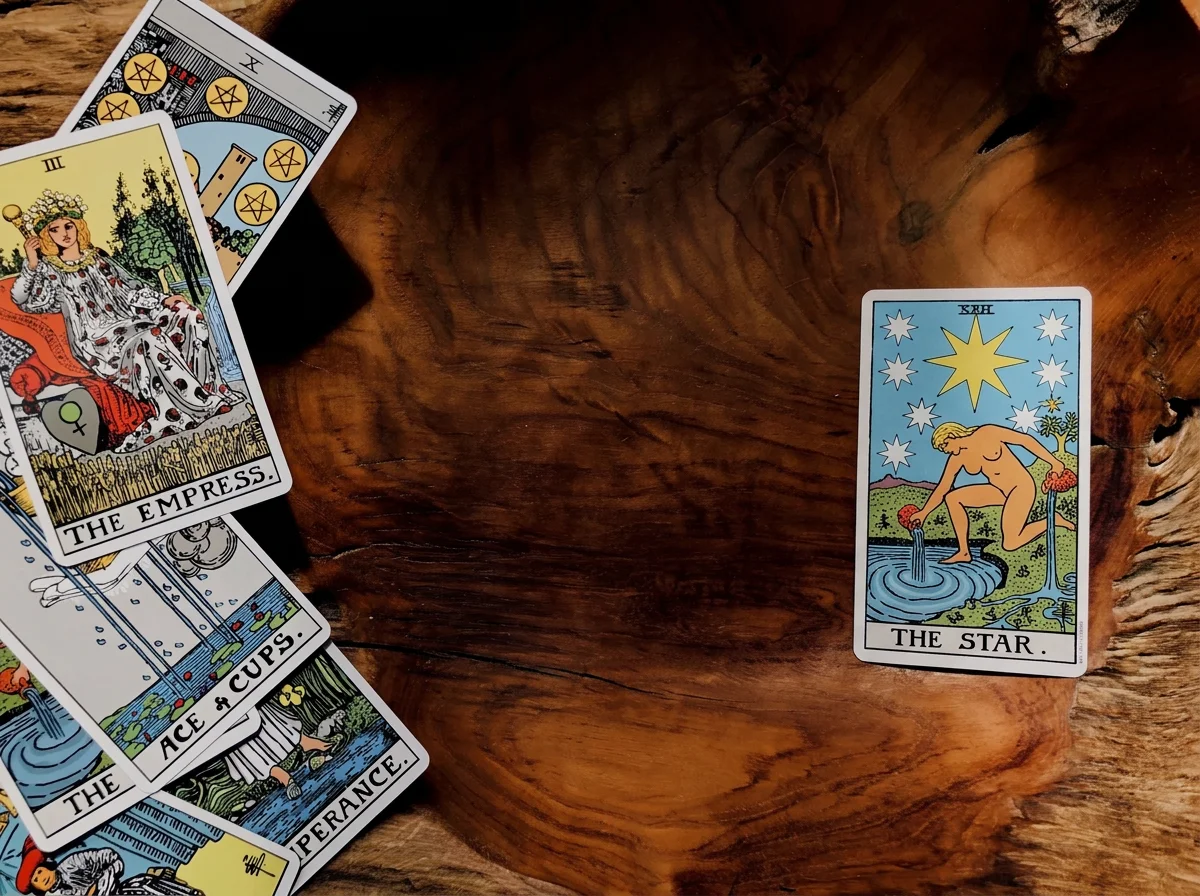
XVII · THE STAR
After the upheaval of The Tower comes The Star.
The landscape is open again. A woman kneels beside the water, pouring from two vessels, one onto the earth and one back into the pool. Above her, the stars shine in a clear sky.
The Star is a card of hope, renewal and the gradual return of trust.
But its hope is not blind optimism. It comes after something has been stripped away. This is what gives the card its particular quality. The Star does not promise that nothing difficult will happen. It asks whether, after disappointment or disruption, we are still willing to imagine that something different might be possible.
Sometimes hope itself requires courage.
When something hasn't worked out, protecting ourselves from further disappointment can feel sensible. We lower our expectations, become more cautious, or stop allowing ourselves to want something quite so much.
The Star gently asks what that protection might also be costing us.
There is vulnerability in the traditional image. The woman is naked, with nothing to conceal and very little separating her from the landscape around her. Yet she does not appear exposed or afraid. There is a sense of being able to exist without armour.
The Star can therefore appear when confidence is beginning to return, when inspiration reawakens, or when a future that had become difficult to imagine starts becoming visible again.
Its shadow can be idealism without grounding, waiting for life to deliver something simply because we believe it should, or becoming attached to a vision of the future that prevents us from engaging with the present.
Hope works differently when we participate in it.
What might become possible if you allowed yourself to hope again without needing to know exactly how everything will unfold?
The astrological connection
The Star corresponds with Aquarius, a fixed Air sign traditionally ruled by Saturn and, in modern astrology, associated with Uranus.
This combination is fascinating because Aquarius contains both continuity and disruption.
Its traditional ruler, Saturn, is concerned with structure, time and what can endure. Its modern ruler, Uranus, is associated with innovation, awakening, independence and breaking established patterns. Together they describe something central to The Star: the ability to imagine a different future and then give that vision enough structure to become meaningful.
Aquarius belongs to Air, the element of thought, perspective, ideas and possibility.
After the Tower has disrupted an existing structure, Air allows us to stand back and ask a new question: What else could there be?
But Aquarius is fixed Air.
This isn't simply an interesting idea that passes through the mind. Fixed Air can hold onto a vision, principle or ideal even when the surrounding world has not yet caught up with it. At its best, this gives Aquarius extraordinary independence of thought and commitment to what it believes is possible.
Its shadow is equally important. A vision can become an ideology. Independence can become detachment. We can become so committed to how the future should look that we stop responding to what is actually happening.
The Star therefore asks us to hold a vision without becoming imprisoned by it.
Your natal Saturn and Uranus, their signs, houses and aspects, can tell us more about the relationship between stability and change in your life. Aquarius's house in your chart can show an area where independence, difference, community, ideals or the desire to do things in your own way may become especially significant.
And what is happening to Aquarius, Saturn or Uranus in your chart now?
Current transits can coincide with periods when an old structure is being reconsidered and a different possibility begins to emerge. Sometimes the future arrives through disruption. At other times it begins much more quietly, as an idea or hope that refuses to disappear.
Tarot can take the enquiry further. What are you beginning to believe might be possible? Where have you protected yourself by expecting less? Is your vision asking only to be dreamed about, or is there something you can begin doing to meet it? And what would it mean to trust the future without demanding that it arrive exactly as you imagined?
-
XVIII · THE MOON
The Moon illuminates, but not in the same way as the Sun.
Its light is reflected, softer and less certain. Shapes become ambiguous, familiar landscapes look different, and imagination begins to fill the spaces that daylight would make clear.
The Moon is a card of intuition, uncertainty, dreams and the world beneath the surface of conscious thought.
Sometimes it appears when we sense something before we can explain it. A feeling persists, a dream stays with us, or something about a situation doesn't quite match what we are being told.
But The Moon also asks us to be careful.
Not every feeling is a prediction. Not every fear is intuition. When information is incomplete, the mind is remarkably good at constructing a story to fill the gap.
This is one of the great tensions within The Moon: how do we distinguish intuition from projection?
Intuition often arrives quietly. Fear tends to become louder the more attention we give it. Yet the distinction isn't always obvious, particularly when we are emotionally involved in a situation.
The traditional image captures this beautifully. A path disappears into the distance between two towers, while a dog and wolf respond to the Moon above. Something primitive and instinctive has been awakened, while a creature rises from the water below, suggesting material emerging from deeper, less conscious territory.
The Moon can therefore invite us to pay attention to dreams, symbols, emotional responses and recurring impressions without immediately demanding that they provide a definite answer.
Its shadow is confusion, illusion or allowing imagination to become more convincing than reality. But excessive rationality has a shadow too. We can dismiss information simply because we cannot yet explain how we know it.
What are you sensing, and how might you explore it without immediately deciding what it means?
The astrological connection
In the traditional esoteric Tarot system, The Moon card corresponds with Pisces, a mutable Water sign traditionally ruled by Jupiter and, in modern astrology, associated with Neptune.
There is an important distinction here.
In astrology itself, the Moon rules Cancer. So the Tarot card called The Moon does not formally correspond with the astrological Moon or Cancer. Its zodiacal correspondence is Pisces.
That apparent anomaly actually gives us a richer way of understanding the card.
Pisces belongs to Water, the element of feeling, intuition, imagination and receptivity. Its boundaries are more permeable than those of the other Water signs. It can be extraordinarily sensitive to atmosphere, symbolism and what is communicated without words.
Pisces is also mutable Water.
Mutable signs adapt and shift. Water already takes the shape of its container, and mutable Water intensifies that quality. This gives The Moon its fluidity. Perception changes according to where we stand, what we feel and what is moving around us.
That sensitivity can be deeply intuitive, but it can also make discernment more difficult. What belongs to you, and what have you absorbed from the atmosphere around you?
Neptune, Pisces's modern ruler, adds symbolism, dreams, imagination, idealisation and the dissolution of boundaries. Jupiter, its traditional ruler, brings another dimension: the search for meaning and the tendency to create a larger story from what we experience.
But the astrological Moon and Cancer are still worth exploring because of the card's imagery and subject matter. The natal Moon describes instinctive emotional responses, memory and what helps us feel safe, while Cancer connects us with belonging, protection and emotional history.
Your chart therefore gives us several places to look: Pisces and Neptune for sensitivity, imagination and porousness; Jupiter for meaning and belief; and your Moon and Cancer for instinct, memory and emotional response.
And what is happening to these parts of your chart now?
Current transits can coincide with periods when sensitivity is heightened, dreams become more vivid, certainty becomes harder to maintain, or something previously beneath the surface begins making itself felt.
Tarot can take the enquiry further. What keeps returning to your attention? What changes according to your emotional state? What arrives quietly, and what becomes louder through fear? And if you don't yet have enough light to see the whole path, what do you know about the next step?
-
XIX · THE SUN
After the uncertainty of The Moon comes The Sun.
What was indistinct becomes visible. The landscape is illuminated, the sunflowers turn towards the light, and the child rides openly beneath the Sun with nothing to conceal.
The Sun is a card of vitality, clarity, joy and the freedom to be fully present in your own life.
Sometimes it appears when something is becoming simpler. A period of uncertainty begins to clear, confidence returns, or you suddenly recognise what matters without needing to analyse it endlessly.
There is an openness to this card.
The child in the traditional image is unselfconscious. There is no attempt to impress, perform or hide. The pleasure of the moment is enough.
That gives The Sun a deeper meaning than simply “happiness”.
It asks what happens when we allow ourselves to take pleasure in being alive.
What makes you lose track of time? What brings warmth, energy or enthusiasm back into your life? Where do you feel most naturally yourself, rather than adapting to what you imagine other people expect?
The Sun can also represent visibility. Something may be ready to be seen, acknowledged or celebrated. That might be a creative project, an achievement, a relationship or simply a part of yourself that you are becoming more comfortable expressing.
Being seen can be more complicated than it sounds. We may long for recognition while simultaneously feeling exposed by it. Sometimes it feels safer to remain slightly hidden, to minimise an achievement or temper our enthusiasm rather than risk appearing too much.
The Sun asks whether you can allow yourself to be visible without turning visibility into performance. There is a difference between seeking attention and simply no longer hiding your light.
Its shadow can appear when confidence becomes self-importance, when the desire to be recognised becomes dependent upon applause, or when positivity leaves no room for more complicated feelings.
The Sun doesn't ask us to pretend that everything is wonderful. It reminds us that joy can be real even when life is imperfect.
What genuinely lights you up, and are you giving it enough room in your life?
The astrological connection
The Sun card corresponds directly with the Sun itself.
Unlike The Moon card, where the name of the card and its formal astrological correspondence are different, here they are exactly the same. The Sun's traditional Tarot correspondence is the astrological Sun.
Because this is a planetary rather than zodiacal correspondence, The Sun card does not formally belong to a single zodiac sign or element.
However, in astrology the Sun rules Leo, a fixed Fire sign, and that relationship gives us a valuable way into the card's symbolism.
Fire represents vitality, creativity, confidence, desire and the impulse to express ourselves. Leo's fixed quality sustains that fire, allowing something individual to develop strongly enough to be seen.
But there is an important difference between The Sun and Strength.
Strength formally corresponds with Leo and explores the conscious relationship with instinct, courage and sustained inner power. The Sun corresponds with the solar principle itself: identity, vitality, creative life force and the developing experience of being fully yourself.
The astronomical symbolism is beautifully appropriate. The Sun is the centre of our solar system, and astrologically it represents a central organising principle within the personality. Its sign describes qualities we are developing and expressing, while its house shows an area of life in which that solar energy seeks expression.
The Sun also illuminates.
Symbolically, what comes into sunlight can be recognised more clearly. This is why the card can accompany moments of revelation, confidence or visibility. Something that previously existed privately may be ready to occupy more space.
Your natal Sun, its sign, house and aspects, can tell us much more about where you derive vitality, how your sense of identity develops and what allows you to feel creatively engaged with your life. Leo's house in your chart adds another layer, showing where visibility, self-expression, creativity and the desire to shine may become particularly significant.
And what is happening to your Sun now?
Current transits to the natal Sun can coincide with periods when identity, confidence, purpose or visibility are being developed or challenged. Sometimes life asks us to step forward. At other times we discover that what once gave us energy no longer does, and something different is trying to come alive.
Tarot can take the enquiry further. What gives you energy rather than simply consuming it? Where are you becoming more visible? What are you ready to enjoy without analysing or justifying it? And what might happen if you allowed yourself to take up your own place in the sunlight?
-
XX · JUDGEMENT
Judgement begins with a call.
In the traditional image, an angel sounds a trumpet while figures rise from their graves below. Something has awakened them. They are responding to a summons that can no longer be ignored.
This is a card of awakening, reckoning and answering the call to become something more fully.
Despite its name, Judgement is not primarily about being judged by somebody else. It is much more interesting when understood as the moment when we see ourselves and our lives from a different perspective.
Sometimes that involves looking backwards.
A decision, relationship or period of life may suddenly make more sense than it did while we were living through it. We can recognise patterns, understand why certain choices were made, and perhaps see that an experience we once regarded simply as a mistake contributed to who we have become.
Judgement therefore contains the possibility of forgiveness, but not necessarily in a sentimental sense. It can mean releasing ourselves from the need to keep reliving an old verdict about who we were, what we should have done or how differently life ought to have unfolded.
The past cannot be rewritten, but our relationship with it can change.
And that is where the card turns towards the future.
There are moments when we realise that we cannot continue living according to an old identity simply because it is familiar. Something is calling us forward, perhaps a vocation, decision, truth or way of living that has been quietly gathering strength for some time.
Judgement asks whether we are prepared to respond.
Its shadow can be harsh self-judgement, endlessly reviewing the past or waiting for absolute certainty before answering the call. But it can also appear when we are so eager to reinvent ourselves that we fail to recognise the value of what has already been lived.
Awakening doesn't require erasing the past. It means seeing it differently enough that it no longer determines what happens next.
What are you being called towards, and what old judgement might you need to release in order to answer?
The astrological connection
Judgement traditionally corresponds with Fire, although in the Golden Dawn system the attribution is more precisely Fire or Spirit, which gives this card a rather different astrological structure from those assigned directly to a planet or zodiac sign.
The traditional Fire attribution gives us a powerful way into the card.
Fire animates. It brings vitality, inspiration, courage and the impulse to act. In Judgement, Fire is not simply enthusiasm or desire. It is the spark that brings something back to life.
The addition of Spirit deepens this further. The trumpet call can be understood symbolically as something that reaches beyond ordinary preference. We may feel drawn towards a direction before we fully understand why, or recognise that a part of ourselves which has been dormant is demanding expression.
There is a difference between thinking perhaps I should change something and reaching the point where remaining unchanged begins to feel impossible.
That is Judgement.
In modern Tarot and astrology, Pluto adds another fascinating layer to the card through its symbolism of transformation, regeneration and the emergence of what has been buried. The figures rising from their graves make that resonance particularly striking.
But where Death describes the ending and transformation of one state into another, Judgement is closer to what rises afterwards.
That distinction between the two cards is important. Death asks us to release what has completed its cycle. Judgement asks: now that something has ended, who are you becoming?
In your birth chart, Pluto, its sign, house and aspects, can offer one modern route into this archetype, showing where experiences of transformation, power, loss and regeneration may have particular significance.
Because the traditional correspondence is Fire, we can also look at the Fire signs and houses in your chart, and at any planets occupying them, for clues about what inspires, animates and calls you towards fuller expression.
And what is being activated in your chart now?
Significant transits can coincide with periods when an old identity, purpose or direction is being reconsidered and something that has been developing beneath the surface begins demanding acknowledgement.
Tarot can take that further. What is calling you? What from the past can now be understood differently? Which version of yourself have you outgrown? And if the trumpet has already sounded, what would it mean to actually answer it?
-
XXI · THE WORLD
The World is the final card of the Major Arcana, but it is not simply an ending.
At the centre of the traditional image, a figure dances within a wreath while the four figures of the fixed zodiac signs appear in the corners. There is movement within completion, suggesting that reaching the end of one cycle does not leave us standing still. Something has been completed, integrated and made whole enough for another cycle to begin.
The World can appear when we reach a point that once seemed distant. A qualification is completed, a project comes to fruition, a home is established, a relationship reaches a new stage, or a long period of personal development begins to make sense as a whole.
Sometimes the achievement is visible. Sometimes it is entirely internal.
You may simply realise that you no longer respond to something as you once did. A situation that previously held enormous emotional power has lost its grip. You understand something now that you could not have understood at the beginning.
That too is completion.
The World asks us to recognise how far we have travelled.
This matters because human beings are remarkably good at moving the goalposts. We reach something we once wanted and almost immediately begin thinking about what comes next. The World invites us to pause long enough to acknowledge what has actually been accomplished.
There is also an important idea of integration within this card. The journey through the Major Arcana has contained innocence, desire, authority, love, uncertainty, loss, disruption, hope and awakening. The World does not erase any of those experiences. It gathers them together.
Wholeness does not mean that every part of life is perfect. It means that our experiences can begin to belong to the same story.
The shadow of The World can therefore appear when we struggle to recognise an ending. We may keep revisiting something already complete, searching for one more answer, one more conversation or one more piece of proof before allowing ourselves to move on.
At the other extreme, we can rush towards the next beginning without allowing ourselves to feel the satisfaction, relief or even grief that can accompany completion.
What might you be ready to recognise as complete, and what changes when you allow yourself to acknowledge how far you have come?
The astrological connection
The World traditionally corresponds with Saturn.
This is a beautifully appropriate correspondence for the final card of the Major Arcana. Saturn is associated with time, structure, boundaries, responsibility, maturity and the consequences of experience.
We have already encountered Saturnian territory in The Devil, which corresponds with Capricorn, one of Saturn's signs. But the two cards reveal very different faces of the same principle.
In The Devil, structure can become attachment. We may remain bound to something because we have invested so much in it, because it provides security, or because the familiar structure feels safer than the uncertainty beyond it. Saturn there can feel like the wall we cannot imagine crossing.
In The World, Saturn becomes something different. The boundary marks completion.
The structure has served its purpose. The lesson has been lived, the work has been done, and we have reached the outer edge of a particular cycle. Saturn is no longer simply asking us to endure or persevere. It allows us to recognise that we have earned the right to move beyond what we once needed.
That distinction is important. The Devil might ask, what are you still bound to? The World asks, what are you now complete with?
Saturn reminds us that some things cannot be hurried.
A life, skill, relationship or body of work acquires substance through time. We repeat, practise, make mistakes, adjust, persevere and gradually create something that could not have existed at the beginning.
In that sense, Saturn is not only the planet of limitation. It is also the planet of mastery.
The World shows us what can happen when experience has been lived for long enough to become integrated.
There is also a strong symbolism of materialisation here. Something that once existed as an idea, hope or possibility has acquired form. This gives The World an earthy quality, particularly through Saturn's rulership of Capricorn, a cardinal Earth sign concerned with building, achievement and creating structures that endure.
This Earth connection is an interpretative bridge rather than the card's formal correspondence, which remains Saturn. But it helps explain why The World can feel so tangible. This is not simply understanding something intellectually. It is knowledge that has been lived, embodied and made real.
Saturn also traditionally rules Aquarius, which adds another dimension. Capricorn builds within the world as it exists, while Aquarius can look beyond the existing structure and ask what might come next. Together they capture something important about The World: completion contains the seed of the future.
The four figures in the corners of the card add another astrological layer. They are traditionally associated with the four fixed signs, Taurus, Leo, Scorpio and Aquarius, bringing together Earth, Fire, Water and Air. Symbolically, the whole zodiacal world surrounds the central figure. Different elements of experience have found their place within the whole.
In your birth chart, Saturn's sign, house and aspects can show where life asks for patience, responsibility and gradual development, but also where genuine authority and mastery can emerge through experience. The houses ruled by Saturn can add another layer, showing areas of life connected to that longer process of maturation.
And what is happening to your Saturn now?
Major transits involving Saturn can mark important thresholds, periods when we recognise what has endured, what needs restructuring and what we are finally ready to take seriously. Other planets transiting the natal Saturn can also awaken questions about responsibility, commitment, achievement and the structures upon which our lives are built.
The World brings us to the end of the Major Arcana, but the next card is The Fool, numbered zero, ready to begin again.
Perhaps that is the final wisdom of the card. Completion is not the opposite of beginning. It is what makes a new beginning possible.
Tarot can take the enquiry further. What have you completed that deserves to be acknowledged? What have your experiences taught you that you could not have known at the beginning? What are you finally ready to leave behind? And as one circle closes, what new world might already be opening?